
Most ACP vs HPL facade cladding comparisons online are written by whoever’s selling one of the two, so the “verdict” conveniently matches whatever the site sells.
That’s not particularly useful if you’re actually the one signing off on a facade for an office building and living with the consequences for the next fifteen years. This isn’t that!
It’s a straight look at what actually differs between the two materials, weight specifically toward what matters for a commercial office exterior in Indian conditions, not a generic “which cladding is better” answer that ignores the building type entirely.
What You’re Actually Comparing
ACP, or Aluminium Composite Panel, has a core material that is usually made of polyethylene or a fire-retardant mineral compound. This core is placed between two thin aluminium sheets.
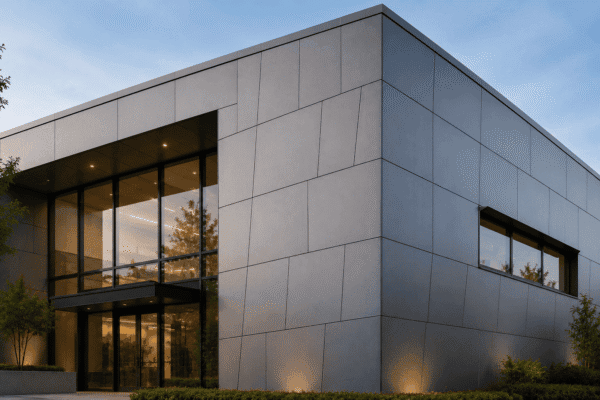
HPL stands for High Pressure Laminate. It is a panel that is made by putting layers of kraft paper together. The kraft paper is soaked in resin. Then it is pressed with a lot of pressure. There is a layer on top of the panel. The result is a smooth surface that looks nice, and the whole process makes a lasting panel.
This is the main structural difference between ACP vs HPL facade cladding. ACP is a layered composite; HPL is essentially one solid material all the way through.
1. Fire Safety
- Standard ACP with a polyethylene core is combustible. Cladding fires involving PE-core ACP have been serious enough globally that many jurisdictions now restrict or ban it above certain building heights.
- HPL generally performs better on fire resistance out of the box, since its solid, resin-based composition lacks the combustible core structure standard ACP has.
- For an office building specifically, higher daytime occupancy and evacuation planning make this worth real attention, not a minor spec detail.
- Always confirm fire rating certificates directly from the supplier, for either material, rather than accepting a general “fire-safe” claim at face value.
2. Weight
- A standard 4mm ACP panel weighs roughly 5.5 kg per square metre.
- A typical 8mm HPL panel weighs closer to 15 kg per square metre, nearly three times as much.
- This isn’t just a shipping detail. Heavier cladding demands more from the supporting substructure and fixing system, which can add structural cost on a large facade.
- For a tall office building, run this weight difference past your structural engineer early, before the material’s already been ordered.
3. Climate Performance in India
- Because of the aluminium skin, the ACP deals with heat expansion. Cooling and shrinking pretty well. The way it’s installed, like a rainscreen lets air move through. Helps manage dampness.
- ACP usually needs polishing to keep its shine. ACP can dent if it is hit by hail or other impacts. ACP may also develop corrosion if it is used in coastal or humid areas over time.
- HPL holds up with fuss, across repeated wet‑dry cycles and intense UV exposure. Color and pattern run through the material, not sit on the surface.
- HPL resists scratches and staining better than ACP, and generally needs only a simple wash to stay presentable, without ACP’s periodic polishing requirement.
4. Design Flexibility
- ACP bends, which is a genuine structural advantage for curves, columns, or non-flat facade elements — common on false ceilings, curved entrances, and wraparound architectural features.
- If an office building’s design includes curved or sculptural elements, ACP is often the more practical choice regardless of other trade-offs.
- HPL is rigid and doesn’t bend the same way, but wins on texture and finish variety — genuine woodgrain, stone, and terrazzo-effect finishes read as more premium and less “plastic” than ACP’s typically glossy, metallic look.
- For an office exterior that wants to look natural and upscale rather than a shiny corporate‑glass style, HPL usually provides a better result. HPL is often the choice for achieving a convincing look.
5. Cost Over the Building’s Lifespan
- ACP generally costs less upfront, which is a big reason it remains the default choice for commercial projects in India.
- Upfront cost isn’t the full picture — factor in ACP’s ongoing maintenance, periodic polishing, more frequent replacement of damaged or corroded panels, and potential future retrofit costs if fire regulations tighten further.
- Once lifecycle costs are factored in, the real gap between ACP vs HPL facade cladding narrows considerably and can reverse entirely on projects with a long ownership horizon.
ACP vs HPL Facade Cladding for an Office Building

| Factor | ACP | HPL |
| Weight (approx.) | ~5.5 kg/m² (4mm) | ~15 kg/m² (8mm) |
| Fire performance | Combustible in standard PE-core form; FR grade required for safety-critical use | Generally better inherent fire resistance |
| Bending / curved facades | Excellent | Poor — rigid panel |
| Surface maintenance | Periodic polishing; can dent or corrode | Wash-and-go; resists scratching and staining |
| Finish range | Glossy, metallic, bold colours | Woodgrain, stone, terrazzo, matte natural finishes |
| Upfront cost | Generally lower | Generally higher |
| Lifecycle cost | Can rise with maintenance and earlier replacement | Often more stable over time |
Which One Actually Makes Sense for Your Office Building
If the design includes facade elements, columns, or architectural features that need to wrap around a form, ACP is likely the more practical structural choice. This holds regardless of factors, as long as you specify fire-retardant grade and confirm HM Innovation in writing.

If the building has a face and if height and occupancy make fire performance a serious concern, then HPL is usually the better long-term option. This is especially true if you’re going for a premium look, one that feels natural and less like a corporate building.
There is no answer that works for everyone. The best choice depends on the design of your building and how tall it is. How many people will be using it. It also depends on how you plan to keep and take care of the property. It’s not about which material came up first in a search. It’s about what fits your project.
Final Thoughts
The decision about ACP vs HPL facade cladding on an office building really comes down to balancing curved‑surface flexibility and the lower upfront cost with considerations of fire performance, surface durability, and long‑term maintenance.
Get fire rating certificates in writing regardless of which material you choose, run the weight difference past your structural engineer before finalizing anything, and think in terms of total cost across the building’s life rather than just the number on the initial quote.